Layer Hen Nutrition: A Feeding Guide for Maximum Egg Production in Cameroon
Posted on September 3, 2026
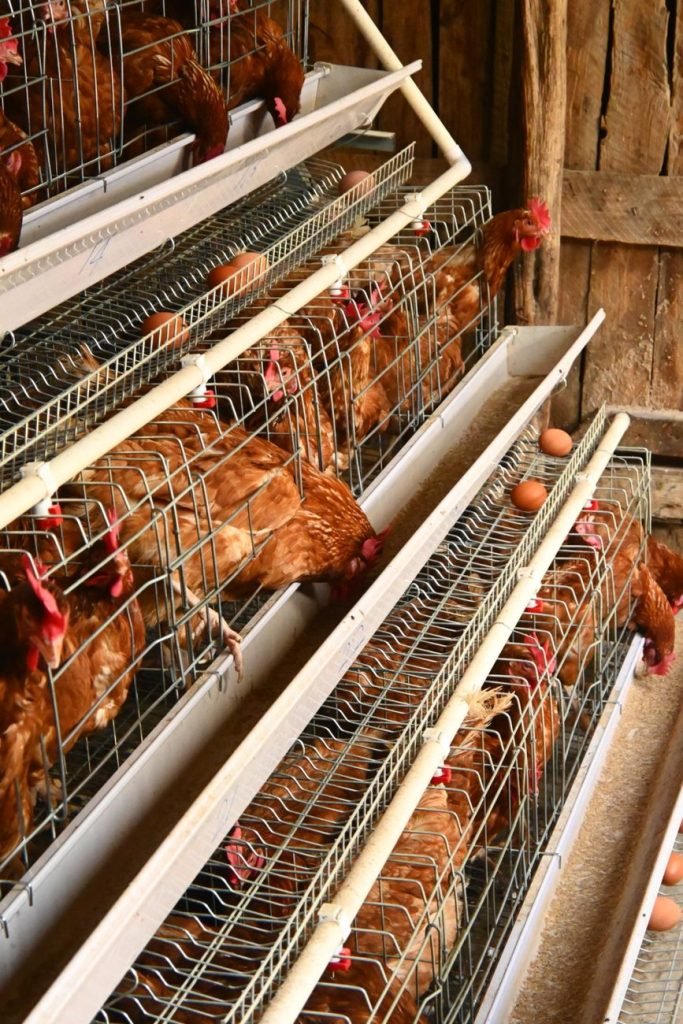
An egg is the return on months of feeding, not a single lucky day. A layer hen fed correctly through her whole cycle — not just once she starts laying — is the difference between a flock that pays for itself and one that never quite does. Commercial layer farming is already a real part of Cameroon’s poultry sector: a 2022 survey of the industry found 70 commercial layer farms and four veterinary pharmacies in the West Region alone.1 This guide sets out what the major layer breeders’ own management guides say about feeding a hen correctly at every stage — and what changes when the climate is Cameroon’s, not Europe’s.
Feeding Phase by Phase
A layer hen’s feed changes several times before she ever lays an egg, and each change matters. Two of the world’s major commercial layer breeders, Hy-Line and Lohmann, publish very similar phase targets2,3:
- Starter (week 1–3): around 19–20% crude protein, about 1% calcium.
- Grower (roughly week 4–8): 17.5–18.5% protein, calcium held near 1%.
- Developer (roughly week 9–17): protein eases down to 15–15.5%, and calcium is deliberately kept low, around 0.9%.
- Pre-Lay (about 2 weeks before first egg, never earlier than 15 weeks): protein rises to 16.5–17.5% and calcium jumps sharply to roughly 2–2.7% — preparing the skeleton for what comes next.
- Layer phases (from first egg onward): protein settles around 15–17%, but calcium climbs to roughly 4–4.5% and keeps rising slightly as the hen ages and lays larger eggs.2,3
That calcium jump — from under 1% to over 4% — is the single biggest change in a layer’s entire feeding programme, and it is worth understanding why.
Calcium: The Difference Between a Good Shell and a Broken Hen
A hen builds an eggshell mostly overnight, largely while she is not eating, using calcium her blood carries from her gut or, if there isn’t enough there, pulled directly from her own bones.4 That is why both Hy-Line’s and Lohmann’s guides recommend shifting from finely ground limestone toward coarser limestone particles (2–4mm) or oyster shell as hens come into lay: coarse particles dissolve slowly in the gizzard, releasing calcium steadily through the night instead of all at once.2,3 Lohmann’s own tropical-climate management guidance goes further, recommending calcium be offered separately, free-choice, alongside the base feed, “allowing hens to self-regulate” — which it says improves feed intake, egg production and shell quality together.5
Getting this wrong has a real medical name: the Merck Veterinary Manual describes “cage layer fatigue,” in which hens with insufficient dietary calcium before or during lay draw so much calcium out of their own skeleton that the bone becomes fragile, sometimes to the point of paralysis or death while a hen is in the process of laying an egg. Merck’s own recommendation is a high-calcium diet of at least 4% for a minimum of seven days before a hen’s first egg, specifically to prevent this.6 An underfed pre-lay hen isn’t just laying a worse egg — she is being quietly damaged by it.
Heat Stress: What Changes for a Layer in Cameroon’s Climate
Layer breeders write their default guides for a temperate optimum: Lohmann cites 23–24°C as ideal, and states that feed intake falls by roughly 1.6% for every degree above 20°C.5 That is not a small margin to lose in a coastal Cameroonian layer house. A 2024 peer-reviewed study measured the effect directly: hens kept at a heat-stress index of 85 (roughly 32.7°C at 66% humidity) produced 11% fewer eggs than hens at a thermoneutral index of 68, laid eggs averaging 48–52 grams instead of 58–60 grams, and had eggshells that were both thinner (0.322mm vs 0.388mm) and measurably weaker.7 The same study found no significant performance loss at the two mildest heat-index levels tested — the damage is real, but it has a threshold, and good ventilation and shade can keep a flock under it.
Practical adjustments recommended by Lohmann for hot climates specifically5,8:
- Feed roughly a third of the day’s ration in the morning and two-thirds in the late afternoon, once temperatures start dropping — and never leave feeders empty for more than an hour during the hottest part of the day.
- A short period of light in the middle of the night (with darkness on both sides of it) encourages hens to eat and drink during cooler hours, and helps deliver calcium overnight when shells are actually being formed.
- Water intake roughly doubles as temperatures climb from 21°C to 38°C, so clean, cool, shaded water matters as much as feed.
- Adding fat to the diet raises energy density without adding as much digestive heat as extra protein or carbohydrate would — useful when birds are eating less overall.
Point-of-Lay and Lighting
Modern commercial layer hybrids reach 50% production at around 140–145 days of age — roughly 20 weeks — and climb to a peak of 94–96% shortly after.2,3 Getting there on schedule depends on controlled lighting as much as feed: day length is deliberately held flat (or even reduced) through the rearing period, then increased step by step from around 10 hours at 16–17 weeks up to 14–16 hours by the time a flock reaches peak lay.2,3 Hendrix Genetics, which breeds the ISA layer lines, adds an important caveat: the right time to start increasing light is a matter of the flock’s body weight and uniformity, not simply its age on a calendar — a flock needs at least 80% uniformity before light stimulation can be applied safely.9
Feed Efficiency and Why It Is Worth Tracking
Feed is widely cited across the industry as the largest single cost in producing eggs, which is exactly why feed conversion is worth recording, not just feed volume. Lohmann’s own performance data puts a good commercial target at 2.0–2.2 kilograms of feed per kilogram of egg mass produced; Hy-Line’s and an Indian agricultural university’s extension figures agree closely, converging on roughly 1.5 kilograms of feed per dozen eggs as a realistic target for a modern hybrid in full lay.2,3,10 A flock running well outside that range, in either direction, is usually telling you something — about the feed, the water, the heat, or the birds themselves.
A Quick Checklist
- Weeks 1–8: starter then grower feed, protein stepping down, calcium held low and steady.
- Weeks 9–17: developer feed, deliberately lean on calcium — do not feed a high-calcium diet before this point.
- 2 weeks before first egg: switch to pre-lay feed, never earlier than 15 weeks.
- From first egg onward: full layer feed, calcium near or above 4%, ideally with some offered as coarse particles or shell, separately if possible.
- Every hot day: feed more in the cooler hours, keep water cool and shaded, and never let feeders sit empty at midday.
The Bottom Line
None of this is exotic — it is a handful of feed changes, timed correctly, plus paying attention on the hottest days. Donguté Group’s feed mill formulates each of these phases specifically, and its layer flocks in Limbe are managed against exactly this kind of tropical-climate adjustment, not a European default.
References
- Mouiche, M. M. M. et al. (2022). Cross-Sectional Survey of Prophylactic and Metaphylactic Antimicrobial Use in Layer Poultry Farming in Cameroon: A Quantitative Pilot Study. Frontiers in Veterinary Science.
- Hy-Line International. (2018). Hy-Line Brown Commercial Layers Management Guide.
- Lohmann Tierzucht. Lohmann Brown-Classic Management Guide.
- Merck Veterinary Manual. Mineral Deficiencies in Poultry.
- Lohmann Breeders. Management of Laying Hens under Tropical Conditions Begins During the Rearing Period.
- Merck Veterinary Manual. Calcium Metabolism Problems in Hens.
- Kim, D., Ryu, C., Lee, S., Cho, H. & Kang, H. (2024). Effects of Heat Stress on the Laying Performance, Egg Quality, and Physiological Response of Laying Hens. Animals, 14(7), 1076.
- Lohmann Breeders. Management of Laying Hens to Minimize Heat Stress.
- Hendrix Genetics. Lighting Program as a Tool to Manage Sexual Maturity and Adjust Egg Size.
- Tamil Nadu Agricultural University, Agritech Portal. Layer Production Indices.