Day-Old Chick Brooding: A Complete Guide to Raising Healthy Broilers in Cameroon’s Climate
Posted on September 3, 2026
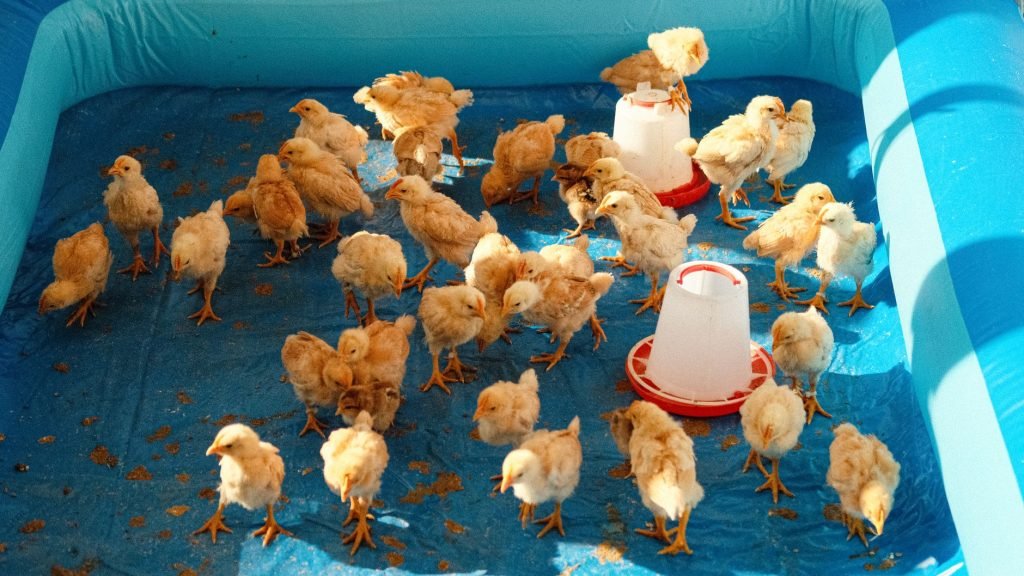
Poultry is one of Cameroon’s fastest-growing farm sectors, but the first three weeks after a chick hatches decide most of what happens afterwards. A broiler that is chilled, dehydrated or crowded on day one rarely catches up later, no matter how good the feed becomes from week four onward. This guide walks through what the research and the major hatchery guides actually say about brooding a day-old broiler chick well — and where a hot, humid climate like the South West Region’s changes the standard advice.
Why the First Three Weeks Matter
Cameroon’s poultry sector has grown fast: production rose by roughly 80% between 2000 and 2007, and the industry now accounts for around 4% of national GDP, with poultry meat and eggs making up about a tenth of all meat produced in the country. Agriculture as a whole still employs about seven in ten Cameroonians, and for many rural households a flock of broilers is one of the more reliable routes to cash income.1 None of that growth is guaranteed at the farm level, though — it is won or lost bird by bird, in the brooder.
Before the Chicks Arrive
Everything should be ready before the box of chicks is opened, not after:
- Pre-heat the brooder so the floor is already at least 32°C under forced-air heat, or around 40.5°C directly under a radiant brooder stove, by the time chicks are placed.2
- Lay supplemental feed on paper or in shallow trays or lids — one per 50 chicks — covering at least half the brooding area, at roughly 50–65 grams of feed per chick.2
- Set out drinkers at a rate of 14–16 per 1,000 chicks, including several bell-type drinkers within easy reach of every chick.2
The First 24–48 Hours
A newly hatched chick still carries a small yolk reserve, but that is not an excuse to delay feed and water: delayed placement or slow access to feed and water increases dehydration and cuts later growth.2 The standard check hatcheries use is simple — pick up a sample of chicks and feel their crops. Within 24 hours, at least 95% should have a full, pliable crop, showing they found both feed and water on their own.2 Fewer than that, and something in the brooder setup needs fixing immediately, not tomorrow.
Getting the Temperature Right
Cobb-Vantress, one of the two broiler breeders whose genetics dominate commercial poultry worldwide, publishes this house-temperature schedule as a starting point2:
- Day 0: 34°C (93°F)
- Day 7: 31°C (88°F)
- Day 14: 27°C (81°F)
- Day 21: 24°C (75°F)
- Day 28: 21°C (70°F)
- Day 35: 19°C (66°F)
- Day 42: 18°C (64°F)
These are guides, not fixed rules — the birds themselves are the real thermometer. Chicks huddled tightly under the heat source are cold; chicks scattered to the edges of the room, panting, are too hot. Comfortable chicks spread out evenly and move around freely.3
Humidity and Ventilation in a Tropical Climate
This is the section where most imported “how to brood chicks” advice needs adjusting for Cameroon. Cobb-Vantress’s own management guide is direct about it: natural ventilation “is common in temperate regions where the climatic conditions are similar to the desired production requirements. It is not recommended to employ this system in regions with climatic extremes.”2 Coastal, humid conditions like Limbe’s are exactly the case that warning is written for.
A few adjustments matter more here than in a temperate-climate guide:
- Stocking density. In warmer climates, a stocking density closer to 30 kg of bird per square metre is nearer the ideal than the higher densities used in cooler, well-ventilated housing.2
- Ammonia builds up fast in humid air, and young chicks pay for it disproportionately. Ammonia levels that barely affect a seven-week-old flock can cut body-weight gain in seven-day-old chicks by as much as 20%.2 Litter management and airflow in week one are not a minor detail — they show up directly on the scale.
- Be careful with evaporative cooling. It is genuinely useful in hot, dry conditions, but it should not be used above 75% relative humidity, and not before chicks are 28 days old or the house is already above 28°C.2 On the humid coast, that rules it out for most of the brooding period — airflow and shade do the work instead.
- On the hottest days, pull feed for a few hours around the peak heat to reduce the metabolic heat load of digestion, and walk through the flock regularly to encourage birds to keep drinking.2 Water itself matters too: intake drops once water climbs above about 30°C, and birds largely refuse to drink water above 44°C, so a shaded, insulated water line is worth the effort.4
Feeding for Growth: Starter Crumble and Feed Conversion
A broiler starter feed is typically formulated at 21–22% crude protein and fed as a crumble for the first one to two weeks, stepping down to a 19–20% grower and finally a 17–18% finisher as the bird matures.5 The reason to get this progression right isn’t just growth rate — it’s feed efficiency. Under standard genetic-potential conditions, a modern broiler converts feed to bodyweight at roughly 1.32 at five weeks, climbing to around 1.56 at six weeks and 1.69 at seven weeks of feed conversion ratio (kilograms of feed per kilogram of bodyweight); real farm conditions, which include some mortality that these genetic tables don’t count, typically run a little higher than that.5 The lower that number, the more meat a farmer gets out of every bag of feed — which is the whole economic logic of paying attention to brooding in the first place.
Newcastle Disease: Cameroon’s Costliest Poultry Threat
The FAO does not soften this one: Newcastle Disease is “the single greatest constraint on the production of village poultry” across Africa and Asia, capable of up to 100% mortality in an unprotected flock during an outbreak, and its constant threat is itself a reason many smallholders hesitate to invest more in their birds.6 Two live vaccine strains are used worldwide: the milder HB1 strain, and La Sota, which produces a stronger immune response but also a more noticeable reaction, especially in birds with no prior immunity.6 Heat-tolerant vaccine strains were developed specifically so vaccination programmes do not collapse when a reliable cold chain isn’t available — a real constraint in many rural parts of West Africa.6
Timing matters as much as the strain: chicks can be vaccinated from as early as one day old, though delaying to the second or third week avoids the vaccine being neutralised by antibodies the chick received from its mother.7 Because the right schedule depends on the specific vaccine, the disease pressure in the area, and whether the chicks came from a vaccinated parent flock, this is a conversation to have with a vet or a hatchery you trust, not a one-size-fits-all rule to copy from a website.
A Quick Day-by-Day Checklist
- Before arrival: brooder pre-heated, paper and supplemental feed down, drinkers filled and within reach.
- Hour 1–2: let chicks settle, then check that they’ve found the feed and water.
- Hour 24: crop check — aim for at least 95% full and pliable.
- Week 1: watch chick behaviour, not just the thermometer; adjust litter and airflow to keep ammonia down.
- Every week after: step temperature down gradually, widen the birds’ space, and keep records of feed used against weight gained.
The Bottom Line
None of this requires imported equipment or a large operation — it requires attention in the first two weeks, when it is cheapest to get right and most expensive to get wrong. Donguté Group’s hatchery, feed mill and veterinary pharmacy in Limbe exist because these three things — healthy day-old chicks, the right starter feed, and vaccines kept properly cold — are usually the actual bottleneck for a farmer, not ambition or effort.
References
- Tambi, N. E. & Nadege, M. D. (2024). Broiler Production and Economic Well-being of Poultry Farmers in Bamenda, Cameroon. Eurasian Journal of Economics and Statistics, 1(2), citing FAO (2014).
- Cobb-Vantress. (2012). Broiler Management Guide.
- Aviagen. (2025). Ross Broiler Pocket Guide.
- Aviagen. (2025). Ross Broiler Pocket Guide — water intake and temperature guidance.
- Cobb-Vantress. (2022). Cobb500 Broiler Performance & Nutrition Supplement.
- Food and Agriculture Organization of the United Nations. Newcastle Disease, FAO Animal Production and Health series.
- Merck Veterinary Manual. Newcastle Disease in Poultry.